Induction heating and heat transfer
We evaluate the heating component design and materials, the heat-transfer path to the drum, and the resulting temperature distribution.
CARBONIZATION SERIES
INDUCTION HEATED ROTARY CARBONIZATION FURNACE
Under developmentDesigning the heat-transfer path around the material being processed.
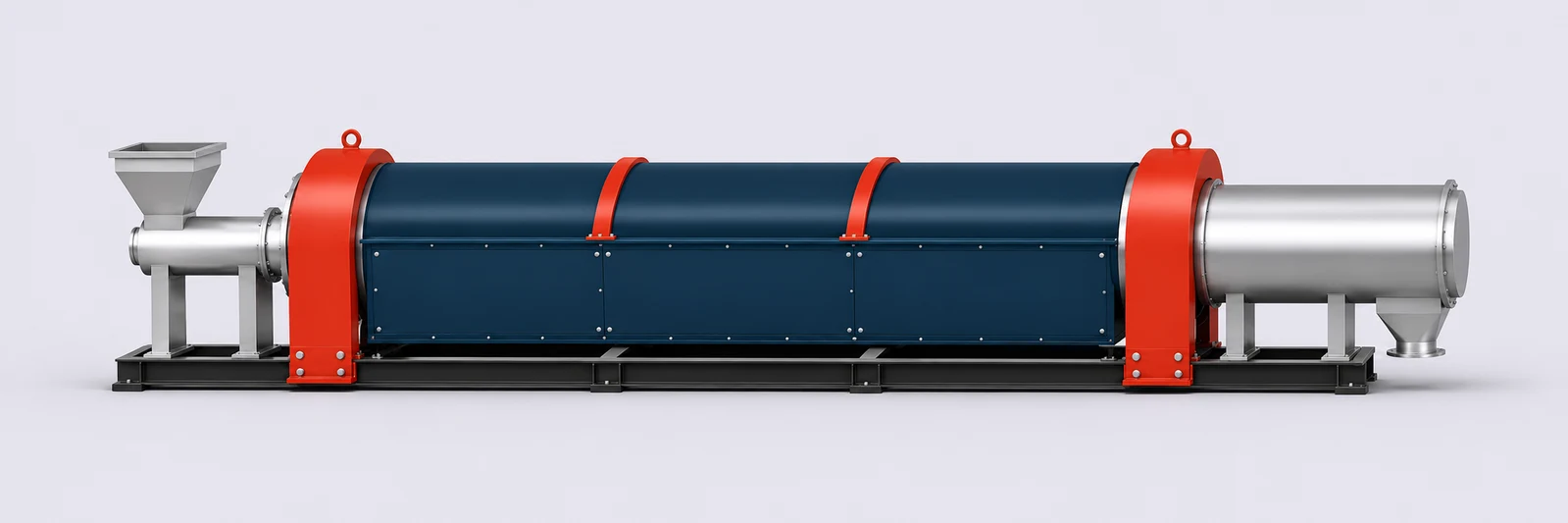
The NTDT Series is a carbonization system under development that combines electromagnetic induction heating with a rotating processing drum.
We evaluate heat transfer, residence time, furnace atmosphere, and off-gas treatment for each feedstock to identify suitable processing conditions.
Product overview
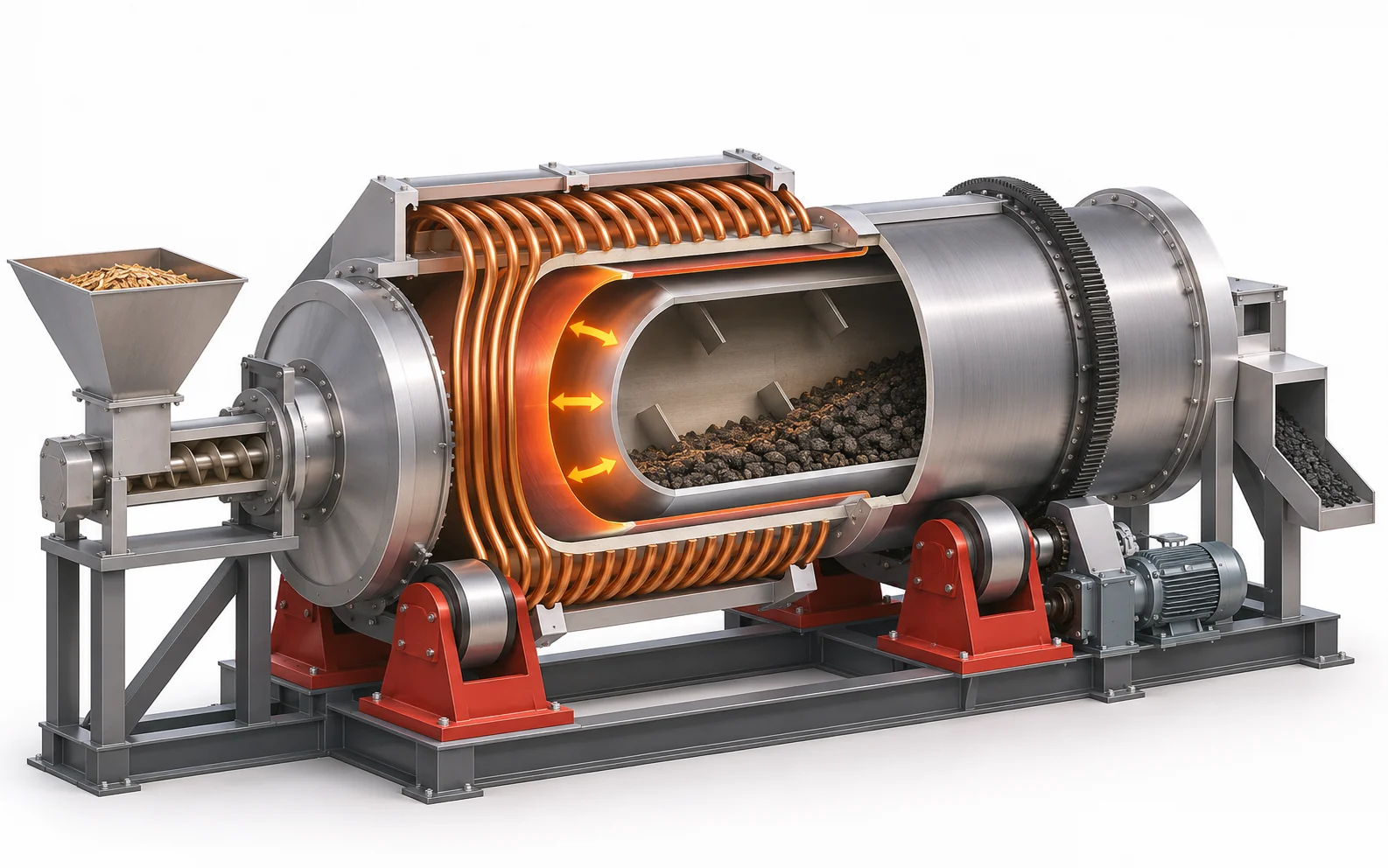
The rotary drum conveys and mixes the feedstock under controlled heating conditions. We are evaluating nitrogen purging and other methods of managing oxygen concentration, along with how to integrate feeding, carbonization and discharge. The design and operating conditions are evaluated against feedstock characteristics including moisture content, particle size and tendency to adhere.
PROCESS & STRUCTURE
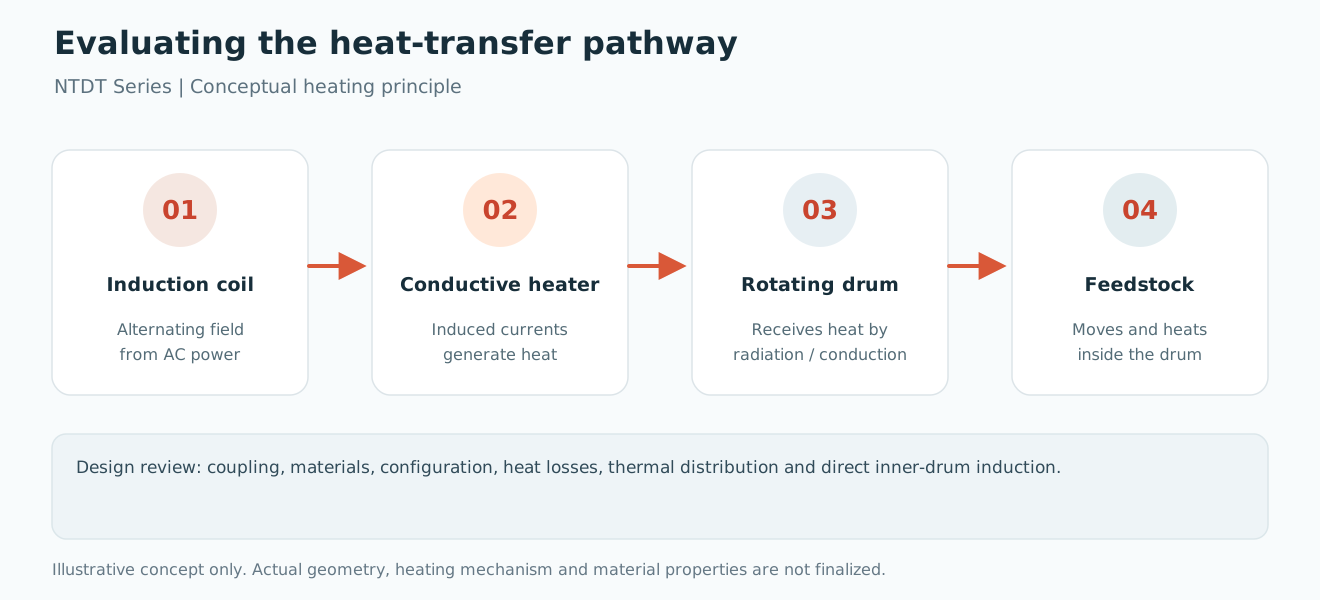
Alternating current in the induction coil produces a varying magnetic field. This field induces currents in electrically conductive components that couple to it, causing them to heat up.
When the heating component and the rotating processing drum are separate, heat passes to the drum by radiation, conduction, or other mechanisms before reaching the feedstock.
For the NTDT Series, we evaluate the heating component design, inner drum material, heat-transfer path, and temperature distribution. The feasibility of directly heating the inner drum by induction depends on material, layout, and electromagnetic shielding.
FEATURES
We evaluate the heating component design and materials, the heat-transfer path to the drum, and the resulting temperature distribution.
We evaluate how rotation affects conveying, mixing, and residence time, taking feedstock particle size and adhesion into account.
We evaluate suitable temperature and residence time for each feedstock, along with oxygen control and nitrogen purging where required.
We assess requirements for pretreatment, feeding, cooling, and off-gas treatment based on moisture content, composition, and thermal decomposition products.
APPLICATIONS
These materials are candidates for suitability evaluation. Feasibility is assessed for each feedstock. Gypsum board and plastics require application-specific equipment design and a safety assessment that accounts for composition, thermal decomposition products, corrosive or hazardous constituents, and off-gas characteristics.
PROCESS FLOW
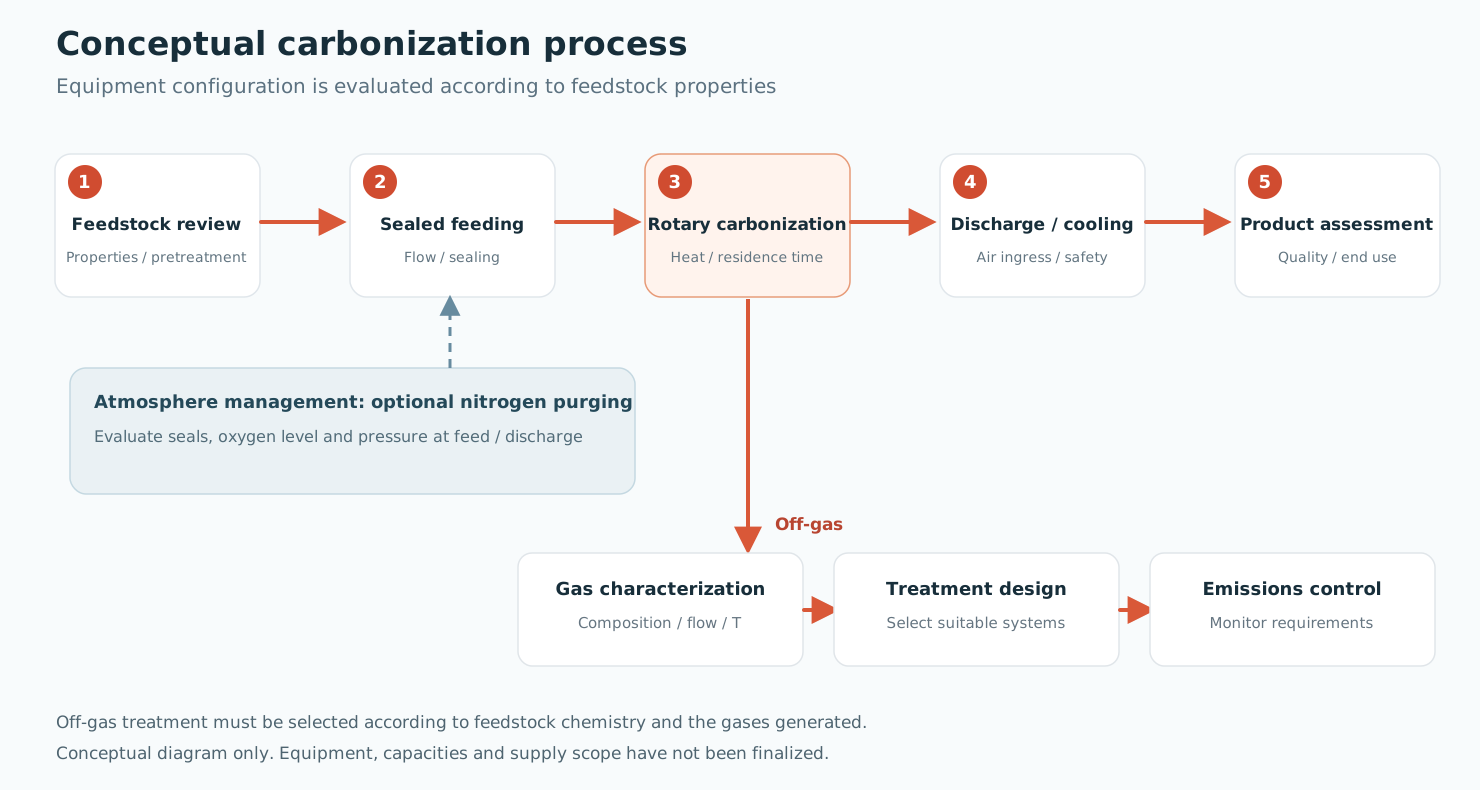
Off-gas from carbonization follows a separate treatment route. Equipment is selected based on feedstock composition and gas characteristics. Nitrogen purging and oxygen control are considered as needed. The equipment configuration, nitrogen supply, off-gas treatment method, and standard scope of supply remain under evaluation.
SPECIFICATIONS
| Product name | Electromagnetic Induction-Heated Rotary Carbonization Furnace | Series | NTDT Series |
|---|---|---|---|
| Heating method | Electromagnetic induction heating | Processing method | Rotary |
| Feed system | Under design review | Throughput | Under development and evaluation |
| Operating temperature | To be evaluated for the design conditions | Atmosphere management | Nitrogen purging and other methods under evaluation |
| Off-gas treatment | Evaluated separately for each feedstock | Product status | Under development |
DEVELOPMENT STATUS
The heating structure, heat transfer, feedstock conveyance, atmosphere management and off-gas treatment are under design and evaluation. The information here describes design objectives and areas under review. Validated values for rated throughput, power consumption, operating temperature, process efficiency and energy savings have yet to be published.
CONSULTATION
Please share the information available about your feedstock and project so that we can consider an appropriate evaluation.
Identify the material, its source, composition and any contaminants.
Discuss the planned input rate, moisture, particle size and tendency to stick.
Outline the desired temperature, residence time and atmosphere.
Discuss intended uses for the output and the objectives of testing or joint development.
FAQ
Organic sludge and food residues are among the candidates for evaluation. Suitability must be assessed for each feedstock.
The treatment method is evaluated individually according to feedstock composition and gas characteristics.
The need for nitrogen purging and oxygen control is evaluated according to the required atmosphere and safety conditions.
The equipment is under development. Capacity and power consumption will be discussed in light of development and evaluation results.
CONTACT
We welcome inquiries about feedstock suitability, carbonization process design, and joint development with companies and research institutions.
Please share whatever details you have about the feedstock, planned feed rate, moisture content, desired operating conditions, and the purpose of your project.
We can discuss specific configurations and specifications based on development progress and the results of technical evaluations.